Blog

  •  The Cost of Delayed Building Projects in Abuja and How to Avoid It

     The Cost of Delayed Building Projects in Abuja and How to Avoid It

    Building your dream home or investment property in Abuja is an exciting venture — but delays in the construction process can quickly turn excitement into frustration, and costs can spiral out of control. If you’re considering or already engaged in building projects in Abuja, understanding the risks and costs of delays is critical for smart planning.

    In this article, we’ll explore the real financial, legal, and emotional impact of delayed construction, and how working with experienced real estate professionals like Jepto can help you avoid costly setbacks.

    1. Financial Costs: Rising Material & Labor Prices

    The most immediate cost of construction delays is financial. Building materials such as cement, iron rods, and granite are price-sensitive and frequently increase due to inflation, currency fluctuations, and fuel prices.

    • Delayed projects mean you pay more when the project resumes.
    • Labor costs also rise, especially if workers need to be rehired or retrained.

     Jepto helps clients lock in competitive rates and source quality materials early to avoid inflation-driven cost spikes.

    2. Opportunity Cost: Wasted Time = Lost Revenue

    For investment properties, time is literally money. Every month your building project stalls is a month you lose rental income or appreciation value.

    For example:

    • A 6-month delay in finishing a rental unit could mean ₦3–5 million in lost rent (depending on the area).
    • Missed timelines could also affect plans to sell during a peak market season.

    Jepto offers reliable project management support, ensuring timelines are followed and expectations are met.


    3. Legal Trouble: Breach of Contract & Government Regulations

    Abuja is regulated by development control agencies like the FCDA. Delays can result in:

    • Expired permits
    • Penalties for idle sites
    • Breach of contractual agreements with builders or buyers

    You could also face litigation if investors or partners are involved and timelines are missed.

    Jepto assists clients in navigating Abuja’s regulatory environment to ensure all documents are current and compliant.


     4. Structural Deterioration: Damage to Incomplete Work

    Unfinished buildings are vulnerable to the elements. When construction stops:

    • Water damage, rust, or erosion can affect your foundation or steelworks.
    • Abandoned sites attract vandals and thieves who may steal materials.

    This leads to additional repair costs before work can continue.

     Jepto connects clients with trustworthy site supervisors and security measures to protect ongoing projects.


    5. Emotional Stress & Project Fatigue

    Beyond the financial losses, building project delays can take an emotional toll:

    • Constant calls to contractors with no results
    • Disappointment with missed goals
    • Mental fatigue and frustration

    For many, the stress causes them to abandon projects completely or sell at a loss.

     Jepto provides full project transparency, regular updates, and hands-on support so you always know what’s happening on your site.


    How to Avoid Building Project Delays in Abuja

    If you’re starting or managing building projects in Abuja, here are proven strategies to stay on track:

    Work with Verified Builders & Supervisors

    Avoid hiring workers blindly. Insist on track records, references, and signed contracts.

    Use a Professional Project Manager

    Don’t leave oversight to chance. Hire or partner with professionals who can manage timelines, quality, and workers.

    Get All Approvals Before You Build

    Make sure your title documents, building plans, and permits are 100% approved before breaking ground.

    Budget Beyond the Basics

    Include at least 15–20% contingency in your budget to absorb unexpected costs.

    Partner with a Reliable Real Estate Company

    A firm like Jepto offers complete end-to-end support — from land sourcing and documentation to vetted contractors and construction management.

    Final Thoughts

    Building projects in Abuja offer incredible value — from appreciating land to strong rental yields — but delays can drain your budget, time, and energy. Whether you’re an investor, first-time home builder, or in the diaspora planning to build back home, the key to success lies in proper planning and partnering with the right professionals.

    Jepto is here to support your real estate journey in Abuja. With transparent pricing, reliable teams, and expert guidance, we help you complete your building projects on time and on budget.

    Ready to build smarter? Contact Jepto today for a free consultation on your next project.

  • 7 Things Real Estate Agents May Not Tell You About Buying Land

    Buying land is one of the smartest investment decisions you can make—whether it’s for personal use, development, or long-term resale. But while the benefits are attractive, the process is more complicated than many real estate agents let on. In fact, there are several important factors most agents won’t fully disclose unless you know to ask.

    At Jepto, we believe in full transparency and helping our clients make informed decisions. So before you buy land in Nigeria—especially in booming locations like Abuja, Lagos, or Port Harcourt—here are 7 crucial truths real estate agents may not tell you.

    1. Hidden Additional Costs Beyond the Purchase Price

    Most buyers are told the price per plot and assume that’s the total cost. In reality, purchasing land often comes with hidden fees such as:

    • Survey and Documentation Costs
    • Legal Verification Charges
    • Development or Allocation Fees
    • Commission and Administrative Costs

    These charges can add up quickly, sometimes increasing your budget by as much as 30%. At Jepto, we break down every potential cost from day one, so there are no surprises down the line.

    2. Some Lands Are Undervalued—or Overvalued

    Not every cheap land is a good deal, and not every expensive plot is prime real estate. Unscrupulous agents may promote undervalued land in undeveloped or inaccessible areas, or overhyped plots with inflated prices and unrealistic ROI promises.

    Before you buy land, always request a market-based valuation. Jepto offers in-house land appraisal services that compare market data, future projections, and government planning insights to give you a fair view of the land’s worth.

    3. Market Fluctuations Can Affect Your Land’s Value

    Land doesn’t always appreciate linearly. Market conditions, urban development plans, and changes in government policies can increase or decrease land value dramatically.

    Most agents won’t tell you that your investment might remain stagnant for years or even depreciate. However, our experts at Jepto continuously monitor market trends to advise you on timing your purchase wisely—especially in hot markets like Abuja.

    4. Land Grabbers Are Still a Real Threat

    In many Nigerian cities, land disputes are common. Buying unverified land could expose you to “omo-onile” (land grabbers) or legal claims from multiple parties.

    Some agents downplay these risks or assure you with vague promises. At Jepto, all our lands are fully verified, free from litigation, and registered with appropriate titles. We also assist clients in obtaining C-of-O and Governor’s Consent where needed.

    5. Overhyped Features and ROI May Mislead You

    You might hear claims like “This land will triple in value in 12 months,” or “A new international airport is coming here next year.” While that sounds great, it’s often just marketing fluff without factual backup.

    Jepto insists on evidence-based projections. We analyze government master plans, infrastructure projects, and investment inflows before quoting any expected ROI or highlighting future features of a location.

    6. Land Documentation Is Not Always Straightforward

    A plot with “documents available” doesn’t always mean the documents are legit or complete. Some documents are either forged or pending approval, and this may not be disclosed.

    We handle every land deal with full documentation verification. Jepto works with legal and land registry professionals to ensure your investment is safe, secure, and future-proof.

    7. Your Land Use May Be Restricted

    Some lands fall under green zones, flood plains, or government acquisition, meaning you can’t build or use them the way you intend. Many buyers only find out after they’ve made payment.

    Jepto conducts a comprehensive land use and zoning review before any recommendation. Whether you want to build a home, a hotel, or a warehouse, we’ll confirm the land is suitable—and legal—for that purpose.

    Conclusion: Buy Land the Right Way with Jepto

    Buying land can be one of the best decisions you’ll ever make—if done right. Avoid regrets by working with a real estate company that prioritizes integrity, verification, and your long-term gain.

    At Jepto, we guide you through:

    • Title verification
    • Secure documentation
    • Legal support
    • Market analysis
    • Transparent pricing

    Whether you’re looking to buy land for residential, commercial, or investment purposes, Jepto is your trusted partner for smart, safe, and profitable land acquisition in Nigeria.

  • Real Estate Investment for Nigerians in the Diaspora: How to Start in Abuja

    Real estate investment

    For many Nigerians living abroad, the desire to invest back home is more than emotional—it’s strategic. One of the most stable and profitable investment opportunities available today is real estate investment in Abuja, Nigeria’s capital city. Whether your goal is to build wealth, own a retirement property, or create passive rental income, the Abuja property market presents promising opportunities.

    But how exactly can Nigerians in the diaspora safely and smartly invest in Abuja real estate—especially from thousands of miles away? In this guide, we break it all down.

    Why Choose Abuja for Real Estate Investment?

    Abuja is more than Nigeria’s political capital; it’s also a hotbed for real estate growth. Here’s why it’s ideal for diaspora investors:

    • High Property Appreciation: Property values in Abuja, especially in developing districts, appreciate steadily.
    • Government Presence: Being the seat of power, Abuja enjoys infrastructure development and security.
    • Growing Expat and Business Community: There’s consistent demand for short-let apartments and luxury homes.
    • Urban Expansion: Areas like Lugbe, Lokogoma, Gwarinpa, and Katampe are booming with residential and commercial real estate.

    Steps for Diaspora Nigerians to Start Real Estate Investment in Abuja

    Here’s a clear roadmap to get started—especially if you’re abroad:

    1. Define Your Investment Goal

    Are you buying land to build later, developing rental properties, or flipping real estate for profit? Your goal determines the type and location of property to focus on.

    2. Choose the Right Location in Abuja

    Some top-performing areas for investors include:

    • Katampe Extension & Gwarinpa: Great for residential developments and rentals.
    • Lugbe & Lokogoma: Affordable and rapidly developing.
    • Maitama & Asokoro: Premium areas ideal for luxury real estate investors.

    3. Work With a Trusted Real Estate Company in Abuja

    This is where Jepto comes in.

    As a trusted real estate company in Abuja, we specialize in helping Nigerians in the diaspora navigate real estate deals with full transparency, documentation, and support. From land verification to project completion, we handle everything locally on your behalf.

    4. Verify All Property Titles and Documents

    One of the biggest risks in Nigeria’s real estate market is falling for fraudulent deals. Always verify:

    • Certificate of Occupancy (C of O)
    • R of O or Governor’s Consent
    • Survey Plans and Deed of Assignment

    Jepto provides full documentation checks and lawyer verification so you never have to worry.

    5. Use Virtual Tools for Remote Oversight

    Technology makes remote investment easier than ever. Jepto offers:

    • Live Video Inspections
    • Drone Footage of Sites
    • Digital Payment Options
    • Construction Progress Updates

    You can own and develop a property in Abuja without being physically present.

    6. Register Your Interest & Start Small

    You don’t need to start with a mansion. Many diaspora clients begin with:

    • A plot of land
    • A 2-bedroom rental apartment
    • A buy-to-let shortlet property

    This builds your investment confidence gradually.

    7. Protect Your Investment with Legal Agreements

    Every transaction should come with:

    • Purchase receipts
    • Land agreements
    • Legal contracts that protect your rights—even from overseas

    Jepto partners with licensed real estate lawyers who specialize in diaspora transactions.

    Common Mistakes Diaspora Investors Make (And How to Avoid Them)

    1. Trusting friends or relatives with large sums of money without oversight
      ✅ Solution: Work with verified professionals like Jepto.
    2. Not visiting the property site (or having a verified virtual tour)
      ✅ Solution: Request a live site tour with video proof or drone footage.
    3. Buying properties without proper documentation
      ✅ Solution: Ensure legal verification before any payment.

    Why Work With Jepto Real Estate Company?

    At Jepto, we’ve helped dozens of Nigerians abroad own property in Abuja safely and transparently. Here’s what sets us apart:

    • ✅ Property sourcing & inspection on your behalf
    • ✅ Legal & title verification
    • ✅ Flexible payment plans
    • ✅ Construction support for land buyers
    • ✅ Short-let property setup for rental income

    You don’t need to be in Nigeria to start. We bring Abuja to you—wherever you are.

    Final Thoughts

    If you’ve been thinking about investing in Nigeria, real estate investment in Abuja is one of the smartest and most secure decisions you can make. The key is partnering with a reliable company that understands the unique needs of Nigerians in the diaspora.

    Let Jepto be your trusted eye on the ground.

    Ready to begin your real estate journey in Abuja?
    Send us a message today or visit our website to view available plots, verified listings, and flexible investment plans tailored for diaspora investors.

    ✉️ Contact us

    Have questions about investing from abroad?
    Drop a comment below—we’d love to hear from you!

  • Buying Property for Shortlet Rentals in Abuja: What You Should Know

    Shortlet Rentals in Abuja

    Thinking about tapping into the booming short-stay market? Investing in shortlet rentals in Abuja can be a lucrative way to earn passive income—if you understand the local dynamics. From neighborhood choice to regulatory considerations, here’s everything you should know before buying a property for shortlet rentals in Abuja.


    1. Why Choose Shortlet Rentals in Abuja?

    • High Demand from Business & Leisure Travelers: Abuja’s mix of government functions, conferences, and tourism drives steady interest in short-term rentals.
    • Premium Nightly Rates: Well-equipped shortlet rentals in Abuja often command rates 20–40% above comparable long-term rents.
    • Flexibility: You can use the property yourself during downtime or switch between long- and short-term lets as needed.

    2. Picking the Best Location for Shortlet Rentals in Abuja

    Not all neighborhoods perform equally for shortlet rentals in Abuja. Aim for areas with strong occupancy potential:

    • Central Business District (CBD): Close to ministries, embassies, and conference centers—ideal for business travelers.
    • Wuse & Maitama: Upscale districts popular with expats and tourists looking for premium accommodations.
    • Jabi Lake & Gwarinpa: Leisure spots near Jabi Lake Mall and parks, attractive for weekend getaways.
    • Garki & Asokoro: Established residential zones with quick access to shopping and dining, boosting shortlet appeal.

    3. Regulatory & Community Considerations

    Before listing your shortlet rentals in Abuja, be aware of:

    • FCDA Guidelines: Short-stay rentals must comply with Federal Capital Development Authority regulations—verify zoning and building approvals.
    • Condominium Rules: If you buy an apartment in a gated estate, confirm with the estate management that shortlet rentals are permitted.
    • Security & Insurance: Ensure adequate insurance covers short-term guests and property-damage protection, critical for your investment.

    4. Property Features That Drive Shortlet Success

    Guests booking shortlet rentals in Abuja look for comfort, convenience, and local flair. Prioritize:

    • Reliable Power & Water: Backup generators and water tanks keep reviews high.
    • High-Speed Internet: Essential for business guests and leisure streamers.
    • Fully Furnished & Styled: A modern, minimalist design with local art accents attracts more bookings.
    • Safety Amenities: Gated access, security cameras, and a safe neighborhood earn trust.

    5. Financial Analysis for Shortlet Rentals in Abuja

    Evaluate your potential return on investment by:

    1. Estimating Occupancy Rates: Research similar listings in your chosen neighborhood.
    2. Calculating Expenses: Factor in FCDA levies, cleaning fees, utilities, management costs, and insurance.
    3. Projecting Revenue: Multiply nightly rate by expected occupancy days to forecast monthly income.
    4. Comparing Long-Term Leasing: Ensure short-term letting yields higher net returns than a traditional lease.

    6. Management Options for Your Shortlet Rentals

    Running shortlet rentals in Abuja remotely? You have two main paths:

    • Self-Management: You handle guest communication, check-ins, cleaning, and maintenance—ideal if you live nearby.
    • Property Management Service: A local manager or service (like Jepto’s recommended partners) can handle day-to-day tasks, key exchanges, and guest support, ensuring smooth operations.

    7. Marketing Your Shortlet Listing in Abuja

    Standing out in the market requires:

    • Professional Photos: Showcase bright, clutter-free spaces that tell a story of comfort.
    • Compelling Listing Copy: Use keywords like shortlet in Abuja, “close to Jabi Lake,” or “business-friendly” to improve search visibility.
    • Dynamic Pricing Tools: Adjust nightly rates based on occupancy trends and local events to maximize revenue.

    8. Risks & Mitigation Strategies

    Even the best shortlet rentals in Abuja carry risks:

    • Regulatory Changes: Stay informed on FCTA short-let policies.
    • Occupancy Dips: Build cash reserves to cover lean seasons, such as national holidays when fewer travelers visit Abuja.
    • Property Wear & Tear: Schedule regular inspections and set clear house rules to protect your asset.

    Ready to Launch Your Shortlet Venture in Abuja?

    Investing in shortlet rentals in Abuja offers exciting income potential—but success hinges on smart location choices, compliant operations, and effective management. Jepto is your reliable partner for all shortlet real estate needs: from property sourcing and due diligence to management referrals and marketing insights.

    Contact Jepto today to find your ideal shortlet investment in Abuja and start earning from Nigeria’s capital city’s vibrant short-stay market!

  • How Government Policies Are Affecting Abuja’s Real Estate Market in 2025

    How Government Policies Are Affecting Abuja’s Real Estate Market in 2025

    Abuja’s Real Estate Market in 2025

    The Abuja real estate in 2025 is experiencing a period of strategic evolution, heavily influenced by recent government policies aimed at regulation, growth, and investment stimulation. These policy shifts—ranging from taxation and infrastructure to land reforms and foreign investments—are reshaping how real estate is bought, sold, and developed in Nigeria’s capital.

    Whether you’re a real estate investor, developer, or aspiring homeowner, here are five key ways government policies are impacting Abuja’s real estate market in 2025.


    1. 🏛️ Tighter Land Ownership Regulations and Documentation Reforms

    In response to long-standing issues with land fraud, overlapping claims, and unregulated sales, the Federal Capital Development Authority (FCDA) in 2025 rolled out a more digitized and centralized system for land registration.

    Key reforms include:

    • Mandatory electronic verification of land titles through the Abuja Geographic Information Systems (AGIS).
    • New penalty structures for undeveloped plots after a fixed period of purchase.
    • Stricter scrutiny before issuance of Certificate of Occupancy (C of O).

    Impact on the Market:

    • Property buyers are now more confident in verified land, reducing litigation risk.
    • Prices for documented plots have increased, especially in high-demand areas like Guzape, Katampe, and Jahi.
    • Developers are becoming more cautious and transparent, leading to a more organized market.

    For anyone participating in Abuja real estate in 2025, documentation is no longer optional—it’s essential.


    2. 🏠 Incentives for Affordable Housing and First-Time Buyers

    One of the biggest shifts in 2025 has been the government’s renewed commitment to tackling Abuja’s housing deficit through affordable housing incentives.

    Recent policies include:

    • Tax exemptions for developers building homes under ₦25 million.
    • Federal Mortgage Bank of Nigeria (FMBN) offering subsidized mortgage rates as low as 6%.
    • Land grants and infrastructure support for developers in satellite towns like Kuje, Lugbe, and Idu.

    Impact on the Market:

    • A rise in residential estate developments targeting middle-income earners.
    • Increased homeownership rates among civil servants and young professionals.
    • More investment opportunities for developers who can scale affordable housing models.

    This policy trend is shifting attention from high-end luxury properties to volume-driven affordable housing units.


    3. 📉 Real Estate Tax Adjustments and Compliance Enforcement

    In 2025, the Federal Inland Revenue Service (FIRS) introduced updated tax laws affecting real estate transactions. These include:

    • Capital gains tax enforcement on all property sales above ₦10 million.
    • Stamp duty charges and VAT on certain land and building transactions.
    • Stronger penalties for non-disclosure of rental income by landlords.

    Impact on the Market:

    • Property sellers are now calculating taxes into final prices, pushing up transaction costs.
    • Increased demand for professional legal and tax consultants to handle compliance.
    • Real estate agents and developers are integrating tax planning into project costs and timelines.

    For active players in Abuja real estate in 2025, staying compliant isn’t just smart—it’s now mandatory to stay competitive and avoid legal trouble.


    4. 🚧 Massive Government Spending on Infrastructure Expansion

    The 2025 national budget allocated a significant portion to infrastructure projects in the FCT, particularly those linking the city center to emerging suburbs.

    Key projects include:

    • Completion of the Apo-Karshi dual carriageway.
    • Light rail extension to satellite towns like Kubwa and Gwagwalada.
    • Federal housing road rehabilitation projects across Lokogoma, Galadimawa, and Karmo.

    Impact on the Market:

    • Suburban areas are gaining value due to improved accessibility.
    • Investors are shifting focus from saturated urban zones to growth corridors.
    • New estates are springing up along key roads, attracting young families and commuters.

    These infrastructure upgrades are opening new frontiers in Abuja real estate in 2025, turning previously overlooked areas into investment goldmines.


    5. 🌍 Policies Encouraging Foreign Direct Investment (FDI) in Real Estate

    To attract global capital, the Nigerian government recently reviewed its investment laws in 2025, making it easier for foreign investors to participate in the local property market.

    Policy highlights:

    • Tax holidays for foreign real estate developers investing $5 million and above.
    • Simplified land lease processes for diaspora Nigerians and international firms.
    • Introduction of real estate investment trusts (REITs) to encourage indirect investment.

    Impact on the Market:

    • A surge in high-end real estate developments co-funded by international partners.
    • Better-quality finishing and architectural standards due to foreign competition.
    • Wider range of financing options for large-scale real estate projects.

    With this policy environment, Abuja real estate in 2025 is gradually integrating with global property markets, offering bigger opportunities for partnerships and growth.


    🧭 Final Takeaway: What This Means for Stakeholders

    The policies reshaping Abuja real estate in 2025 are creating a more structured, transparent, and investor-friendly market. While some reforms—like increased taxes and stricter regulations—may appear challenging at first, they ultimately protect long-term interests and encourage sustainable development.

    If you’re considering investing, buying, or developing in Abuja this year, it’s critical to:

    • Work only with verified land and approved agents.
    • Stay updated on tax laws and infrastructure plans.
    • Consider opportunities in suburban markets and affordable housing.
    • Monitor foreign investment trends for partnership or resale potential.

    Jepto remains your trusted partner in navigating these changes. Our team combines policy knowledge, legal support, and real estate insight to help you make the smartest investment decisions in Abuja’s fast-evolving property landscape.

  • How to Invest in Commercial Real Estate in Abuja

    Investing in commercial real estate in Abuja offers lucrative potential: the city’s status as Nigeria’s political and economic hub means strong, steady demand for office space, retail outlets, warehouses, and hospitality venues. In this guide, you’ll learn every step—from market research to lease management—for successful commercial real estate in Abuja investment. And when you’re ready to act, Jepto is your reliable partner for all your commercial real estate in Abuja needs

     commercial real estate in Abuja

    1. Grasp the Market Dynamics of Commercial Realestate in Abuja

    Before putting down any capital, understand where demand and growth are strongest within the commercial real estate in Abuja sector:

    • Prime Districts: Wuse, Maitama, and the Central Business District dominate commercial real estate in Abuja, commanding top rents and high occupancy.
    • Growth Corridors: Airport Road (Lugbe), Gwarinpa, and Kubwa represent the next wave of commercial real estate in Abuja expansion—lower entry prices but rising quickly.
    • Industry Clusters: Idu and Kubwa for light industrial parks; Jabi and Apo for hospitality and co-working spaces—each niche shaping commercial real estate in Abuja.

    By studying rental trends and vacancy rates, you’ll pinpoint where commercial real estate in Abuja delivers the best risk-adjusted returns.


    2. Decide on Your Asset Type in Abuja’s Commercial Realestate

    The term commercial real estate in Abuja covers diverse property classes. Choose one that aligns with your capital and risk profile:

    • Office Buildings: Premium commercial real estate in Abuja assets, offering stable, long-term leases with corporate tenants.
    • Retail Units & Malls: High-foot-traffic commercial real estate in Abuja sites that require close location analysis.
    • Warehouses & Logistics Parks: Industrial commercial real estate in Abuja that benefits from Abuja’s central transport network.
    • Hospitality & Co-Working: Fast-emerging commercial real estate in Abuja, driven by domestic travel and entrepreneurial growth.

    Select the commercial real estate in Abuja sector that best suits your financial goals and management capacity.


    3. Conduct Due Diligence for Abuja Commercial Real Estate

    Rigorous due diligence is critical to any commercial real estate in Abuja purchase:

    1. Title & Zoning Verification: Confirm a valid Certificate of Occupancy and that the property is zoned for your intended commercial real estate in Abuja use.
    2. Building Permits & Compliance: Check that any planned renovations or expansions on your commercial reale state in Abuja asset have proper FCDA approvals.
    3. Physical Inspection: Engage surveyors and engineers to assess structural integrity, utilities, and road access—essential when buying commercial real estate in Abuja.
    4. Comparable Market Analysis: Benchmark lease rates and occupancy for similar commercial real estate in Abuja properties to ensure you’re paying fair value.

    Thorough checks protect you from title disputes, regulatory snags, and unexpected costs in commercial real estate in Abuja.


    4. Secure Financing & Structure Your Abuja Deal

    Funding a commercial real estate in Abuja acquisition often involves multiple channels:

    • Bank Loans & Mortgages: Local banks offer financing for commercial real estate in Abuja, usually requiring a 20–30% equity contribution.
    • Developer Payment Plans: Many developers of commercial real estate in Abuja partner with investors on staggered payment schedules.
    • Joint Ventures: Pool resources with institutional partners to acquire larger commercial real estate in Abuja assets.
    • REITs & Funds: If you prefer indirect exposure, Nigerian Real Estate Investment Trusts hold portfolios of commercial real estate in Abuja.

    Model your cash flows, debt service ratios, and exit yields carefully to determine the optimal financing mix for your commercial real estate in Abuja project.


    5. Leverage Jepto’s Expertise in Commercial Real estate in Abuja

    Navigating title searches, tenant negotiations, and regulatory compliance is easier with a trusted local partner. Jepto provides end-to-end services for commercial real estate in Abuja:

    • Market Intelligence: Real-time data on rental trends, upcoming infrastructure, and vacancy rates.
    • Legal & Regulatory Support: Title verification, zoning clearance, and permit processing for commercial real estate in Abuja.
    • Deal Sourcing & Negotiation: Access to off-market commercial real estate in Abuja listings and skilled negotiation on your behalf.
    • Asset Management: Tenant placement, lease administration, and property maintenance to optimize your commercial real estate in Abuja returns.

    With Jepto guiding your commercial real estate in Abuja journey, you gain confidence at every stage.


    6. Mitigate Risks & Plan for Growth

    Even the best commercial real estate in Abuja investments carry risks—here’s how to safeguard your capital:

    • Vacancy Planning: Maintain reserves to cover loan obligations if a tenant vacates your commercial real estate in Abuja space.
    • Regulatory Monitoring: Stay updated on FCTA zoning amendments affecting commercial real estate in Abuja.
    • Economic Diversification: Hedge against currency and inflation fluctuations by mixing commercial real estate in Abuja with other assets.
    •  Budgeting: Allocate funds for periodic upgrades and compliance to keep your commercial real estate in Abuja asset competitive.

    A balanced risk-management plan ensures your commercial real estate in Abuja investment stays resilient.


    7. Maximize Your Returns on Abuja Commercial Real Estate

    To elevate your commercial real estate in Abuja yields:

    • Value-Add Upgrades: Renovate and rebrand older properties to command premium rents in commercial real estate in Abuja.
    • Flexible Leasing: Short-term retail or pop-up leases can boost revenue per square meter in commercial real estate in Abuja malls and shops.
    • Sustainability Features: Energy-efficient systems and green certifications attract top tenants to your commercial real estate in Abuja asset.
    • Digital Marketing & Virtual Tours: Showcase your commercial real estate in Abuja listings to local and international investors through high-quality multimedia.

    These tactics help you extract maximum value from your commercial real estate in Abuja portfolio.


    Ready to Invest in Commercial Real estate in Abuja?
    Whether you’re new to property investment or expanding an existing portfolio, Jepto is your trusted partner for commercial real estate in Abuja. From sourcing prime assets and verifying titles to securing financing and managing tenants, Jepto delivers expert, transparent service tailored to your objectives.

    Contact Jepto today to explore curated commercial real estate in Abuja opportunities and kickstart your high-yield investment journey!

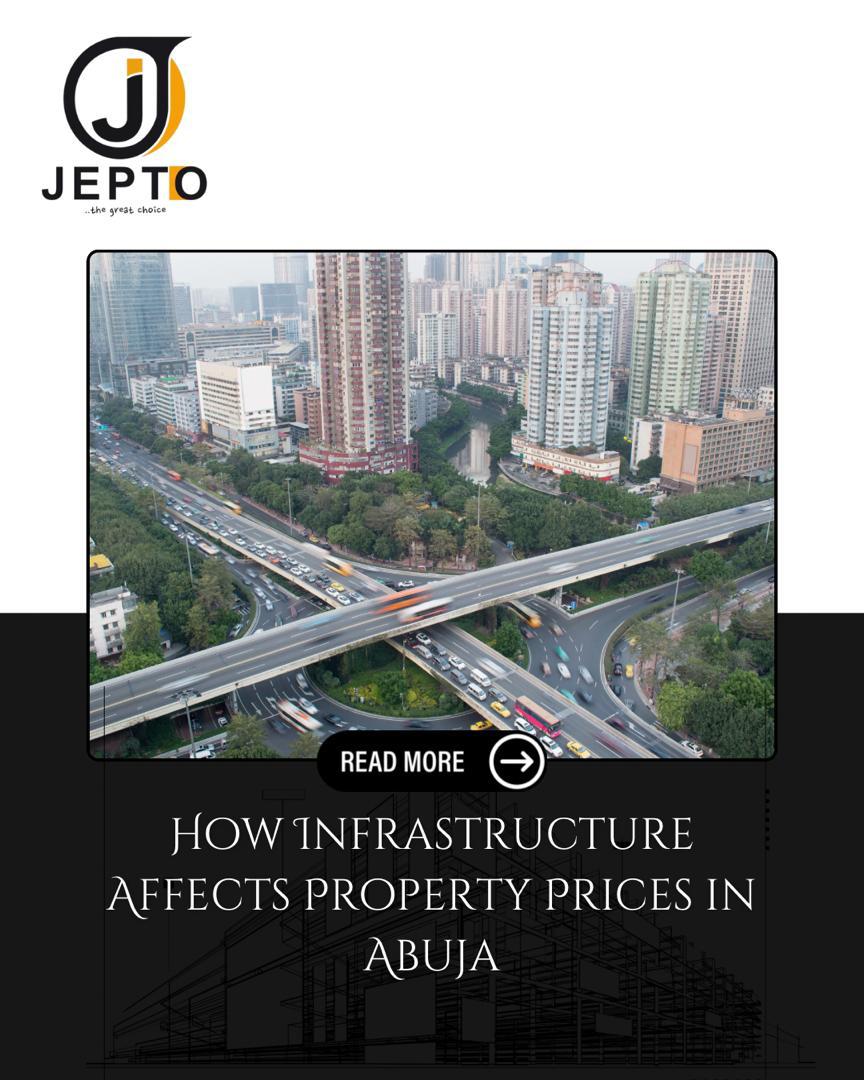
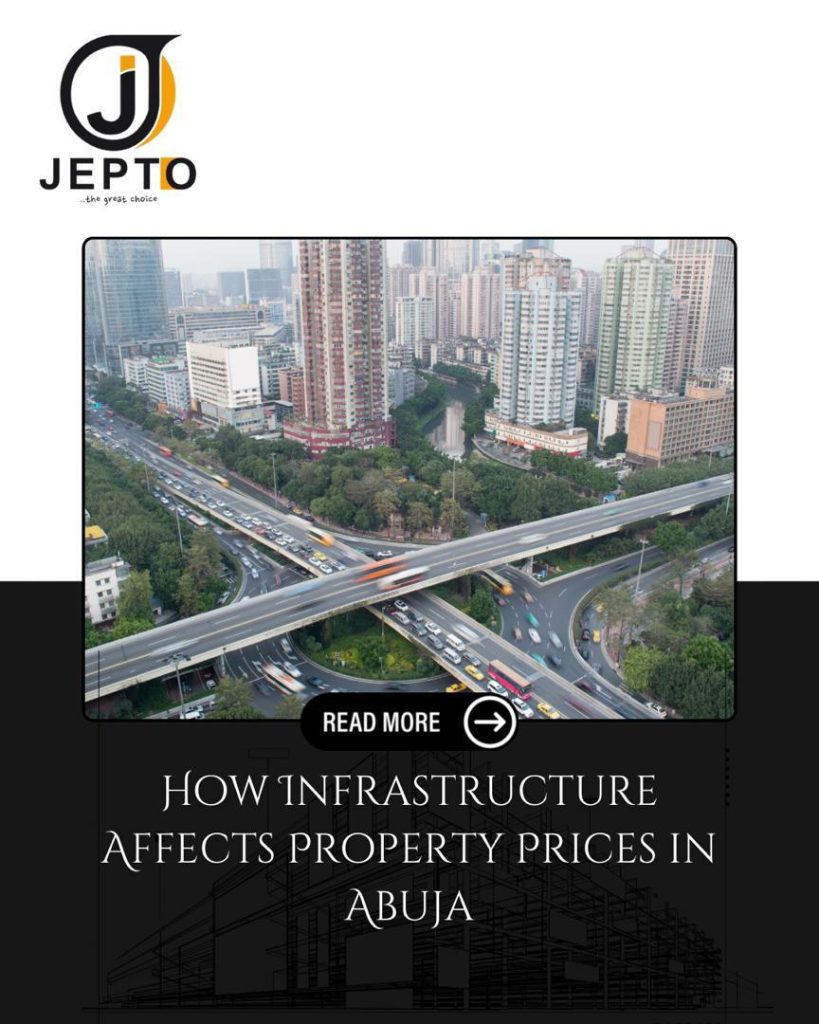
  • How Infrastructure Affects Property Prices in Abuja

    How Infrastructure Affects Property Prices in Abuja

    Infrastructure development is one of the most powerful drivers of property prices in Abuja. As Nigeria’s capital expands, new roads, bridges, utilities, and public services transform neighborhoods—unlocking value and attracting both residents and investors. In this article, we’ll explore how various infrastructure projects influence property prices in Abuja, and why partnering with Jepto ensures you make informed, profitable real estate decisions in the FCT.

    How Infrastructure Affects Property Prices in Abuja

    1. Road Networks & Accessibility

    Impact on Property Prices in Abuja

    • Improved Connectivity: New highways (e.g., Airport Road expansions) reduce commute times, making suburbs like Lugbe and Kubwa more attractive. Lower travel times often lead to a 15–25% uplift in nearby property prices in Abuja.
    • Increased Demand: As accessibility improves, demand for land and homes along major corridors spikes. Areas once considered remote suddenly become prime real estate.

    What to Watch For

    • Upcoming Federal Capital Territory (FCT) road projects
    • Planned ring roads and feeder routes
    • Proposed bus-rapid transit (BRT) lanes

    2. Utilities & Public Services

    Influence on Property Prices in Abuja

    • Stable Power Supply: Neighborhoods with reliable electricity (e.g., through government power plants or solar mini-grids) command higher rents and sales prices. Reliable power can boost property prices in Abuja by up to 20%.
    • Water & Sewage Systems: Access to treated water and modern drainage reduces health risks and maintenance costs, pushing property prices in Abuja upward.

    Key Considerations

    • Check proximity to treatment plants and main water lines
    • Confirm access to municipal waste collection and drainage
    • Look for areas benefiting from new borehole projects or water authority upgrades

    3. Social Amenities: Schools, Hospitals & Markets

    Effect on Property Prices in Abuja

    • Education Hubs: Good schools (public or private) in districts like Gwarinpa and LifeCamp drive families toward these zones, inflating property prices in Abuja for houses and apartments.
    • Healthcare Access: Clinics and hospitals improve quality of life. Properties near medical centers (e.g., in Garki or Maitama) often see a 10–15% premium.
    • Commercial Markets: Well-planned markets and shopping malls create urban centers that raise local property prices in Abuja by concentrating services and foot traffic.

    Practical Tips

    • Map out the “amenity radius”—properties within 1–2 km of top schools or hospitals often enjoy the highest premiums.
    • Investigate planned social infrastructure in Abuja’s master plan to predict future hotspots.

    4. Transportation Hubs & Rail Links

    Role in Property Prices in Abuja

    • Rail Corridors: The Abuja Light Rail project has already begun to reshape values along its route. Properties near rail stations see early investors earning significant gains in property prices in Abuja.
    • Airport Proximity: Areas around Nnamdi Azikiwe International Airport, such as Lugbe, enjoy higher land values as logistics and hospitality sectors grow.

    What to Monitor

    • Completion dates for rail phases
    • New terminal or cargo handling expansions at the airport
    • Planned multimodal transport interchange stations

    5. Security Infrastructure

    Impact on Property Prices in Abuja

    • Gated Communities & CCTV Networks: Developments that include perimeter fencing, security checkpoints, and surveillance systems often list homes at a sizable premium, reflecting lower risk and higher buyer confidence. This directly influences property prices in Abuja, especially in emerging estates.
    • Police Posts & Fire Stations: Proximity to emergency services enhances safety and can lift property values by 5–10%.

    Evaluation Tips

    • Assess developer-provided security features before purchase
    • Research FCTA plans for new police or fire stations in target areas

    6. Telecommunications & Digital Connectivity

    Influence on Property Prices in Abuja

    • High-Speed Internet & 5G: Neighborhoods with fiber optic and 5G coverage are more attractive to professionals and businesses, boosting property prices in Abuja for both residential and mixed-use developments.
    • Smart City Initiatives: Pilot projects for IoT-enabled street lighting or traffic sensors can signal future growth corridors.

    Action Points

    • Verify broadband and mobile network coverage maps
    • Look for planned telecom infrastructure upgrades on FCTA websites

    7. Long-Term Value & Compounding Growth

    Infrastructure improvements rarely happen overnight. As each project completes, property prices in Abuja tend to follow in a phased manner:

    1. Announcement Phase: Prices inch up as savvy investors anticipate growth.
    2. Construction Phase: Speculative buying drives a steeper climb in nearby land values.
    3. Completion Phase: Wider market recognition cements the premium, benefiting early adopters most.

    Investors who track infrastructure timelines and buy before or during the construction phase often achieve the best returns on property prices in Abuja.


    Partner with Jepto for Infrastructure-Savvy Investing

    Navigating the complex interplay between infrastructure and property prices in Abuja requires local expertise. Jepto offers:

    • Up-to-date briefings on FCTA infrastructure plans
    • Data-driven forecasts of how projects will reshape property values
    • Curated property listings aligned with emerging infrastructure corridors
    • End-to-end support—from site visits to title verification

    Contact Jepto today to leverage infrastructure insights and secure your ideal property in Abuja. Let Jepto guide you to the neighborhoods set for the next wave of property prices in Abuja’s growth!

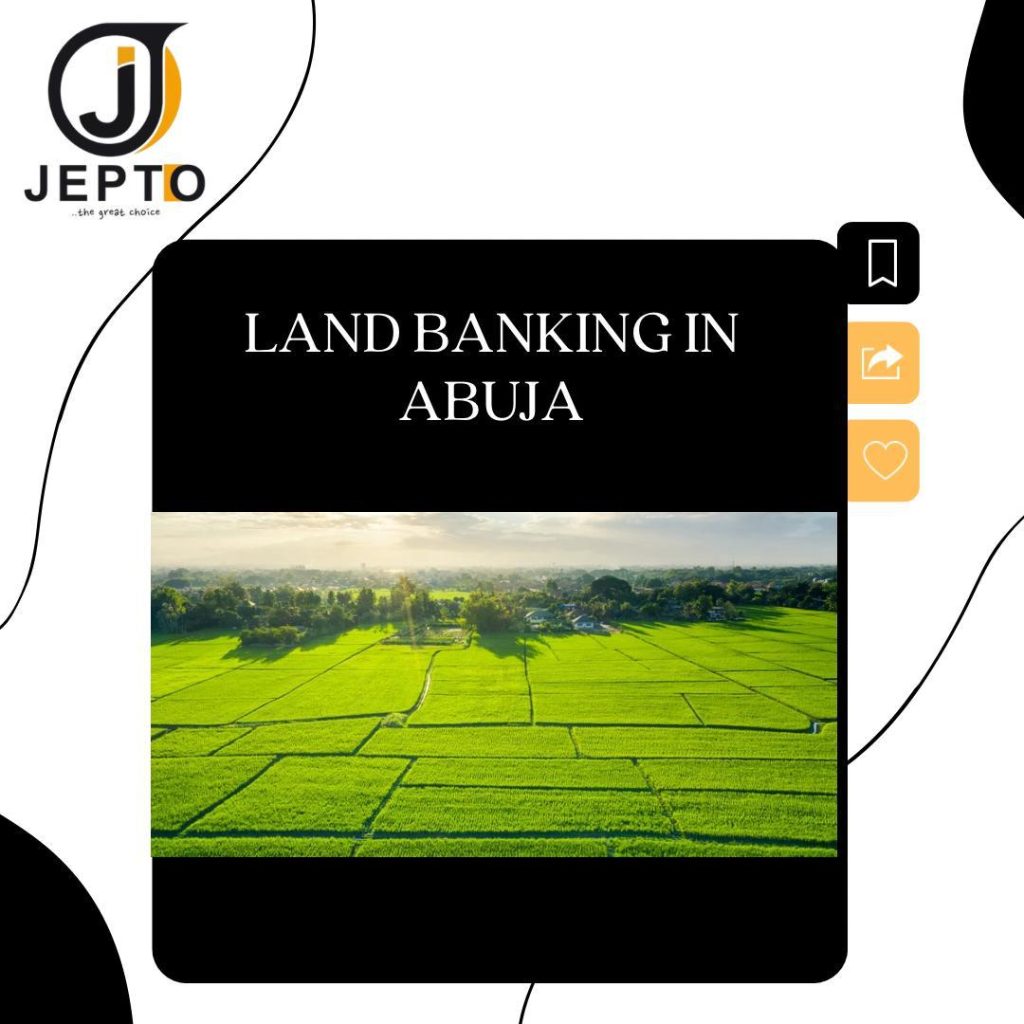
  • Land Banking in Abuja: What It Is & Why It Works

    Landing banking in abuja

    Land banking means buying undeveloped land and holding it until its value rises. In Abuja – Nigeria’s fast-growing capital – this strategy can pay off handsomely. The city’s population boomed about 140% between 2000–2010, and land prices are surging (one report shows land values up ~22.8% year-on-year). With Abuja’s booming growth, limited developable land, and major new infrastructure projects, buying land today often leads to strong returns later. In this guide, we’ll explain why land banking in Abuja works so well, highlight high-growth areas, answer common investor questions, and give practical tips for getting started.

    What is Land Banking?

    Land banking is simply the practice of buying raw or undeveloped land at a relatively low price and holding it long-term until demand and development make it worth much more. Instead of building immediately, you “bank” the land – essentially investing in future growth. Think of it as betting on a neighborhood’s future: you pick areas likely to expand, then wait (often 5–10 years or more) as roads, utilities, or cities grow into the zone. By the time you sell, you can earn multiples of your purchase price. For example, land bought in Abuja’s Jabi area years ago for ₦10 million now fetches over ₦70 million due to surrounding development.

    Why Land Banking Works in Abuja

    Abuja’s unique real estate dynamics make it especially suited to land banking. Key reasons include:

    • Rapid Population Growth: Abuja’s population is booming, driving continuous housing demand. The city grew ~140% from 2000 to 2010 and still expands each year. More people means demand for new neighborhoods and higher land values.
    • Proven Price Appreciation: Recent market data show Abuja land values rising quickly. In fact, one study found Abuja land prices grew ~22.8% in a year, underscoring strong investor demand. Land banking lets you capture this long-term appreciation.
    • Major Infrastructure Projects: New highways, bridges, rail lines, and utilities are reaching far-out districts. For example, the Abuja Light Rail, expanded expressways and planned airport links are opening up previously remote land. Buying near these projects means your land becomes far more valuable once the projects finish.
    • Limited Land Supply: Abuja is a planned city with finite developable land. Urban areas like Garki, Asokoro and Maitama are mostly built up, so the only way to expand is outward. This scarcity makes peripheral land a high-value, inflation-hedging asset. As the saying goes, “Don’t wait to buy land – buy land and wait.”
    • Strong Demand Drivers: As the nation’s capital, Abuja attracts businesses, diplomats, and middle-class families. Rising incomes and security concerns (e.g. gated estates) keep demand for housing and commercial space high. Investors who bought early have seen Abuja’s “residential” and “land” segments outperform other assets.

    Altogether, Abuja’s fast urbanization, huge infrastructure budget, and limited core land supply make it fertile ground for land banking.

    High-Growth Areas (Hotspots)

    Where is this growth happening? Here are some areas to watch, each gaining infrastructure and new developments:

    • Lugbe (Airport Corridor): A booming suburb along the Airport Road, Lugbe benefits from proximity to the airport, dam, and new Metro rail. It’s growing rapidly due to affordable prices and new projects.
    • Kuje: Southwest of central Abuja, Kuje is next to the Kuje Prison and expanding along major roads. Developers are rolling out estates here as city planners improve roads.
    • Kubwa: East of the city, Kubwa is one of FCT’s largest residential districts. Ongoing road expansion and industrial growth (near Idu) are driving land values up. Experts list Kubwa and neighboring Idu as emerging hotspots.
    • Gwagwalada: About 45–50 minutes from Abuja’s core, Gwagwalada is a fastest-growing satellite town. It offers cheaper land and is well-connected via the Abuja-Lokoja expressway and new southern bypasses. The nearby University of Abuja fuels housing demand (students and staff). Many investors see high ROI potential in Gwagwalada thanks to its expanding road and rail links.
    • Kaura & Jahi (Phase 2): These neighborhoods on the city’s southwestern edge are farther out than the established Wuse/Maitama zones. Kaura and Jahi now enjoy newer roads and more housing. They are highlighted among areas witnessing significant growth. As infrastructure moves in, these lands have soared in value.

    Other emerging areas include LifeCamp (near the National Children’s Park), Lokogoma, and the newer Kado/Katampe extensions – all of which see ongoing construction of roads and homes. The common thread is proximity to new schools, markets or transit lines. By targeting such locations, land bankers position themselves ahead of wider development.

    Tips for Getting Started

    If you’re considering land banking in Abuja, follow these practical steps to start off right:

    • Do Thorough Research: Study Abuja’s master plan and recent news. Identify planned projects (new roads, bridges, airports, etc.) and upcoming city extensions. Areas earmarked for development are your best bets.
    • Verify Land Documentation: Always confirm ownership and legal status. Ensure the plot has a valid Certificate of Occupancy (C of O), deed of assignment, survey plan or technical survey plan (TDP), and proof of payment. Working with a qualified real estate lawyer or FCDA-licensed agent can help verify these. Remember, Abuja is notorious for land scams, so never buy sight unseen.
    • Start Small if Needed: If you’re new to land investment, consider beginning with a small plot or a co-investment. Lower-cost parcels let you learn the ropes with less risk. As you gain experience, you can scale up.
    • Check Seller Credibility: Buy only from reputable developers or landowners with a track record. Government-accredited estates or well-known real estate firms add safety. Avoid solo “omoluabi” middlemen without verifiable references.
    • Consider Payment Terms: Some developers offer staggered payment plans, making high-value Abuja land more accessible. Evaluate financing options but guard against interest or penalties.
    • Keep a Long-Term Horizon: Plan to hold your land for several years. Prices typically climb as projects complete – sometimes 5–10 years or more. If you expect a quick flip, you may be disappointed. Land banking pays off as a patient, long-term strategy.
    • Work with Experts: Partner with knowledgeable agents or consultants (like Jepto!) who understand Abuja zoning laws and market trends. They can save you time and protect you from mistakes.

    By following these tips, you’ll minimize common pitfalls and make informed investments.

    Common Investor Questions

    • Patience pays off. Unlike rental property, land banking yields no income until sale. You typically wait several years – often 5–10 years – for infrastructure to raise land values. However, if a project (like a new road) happens sooner, you might sell earlier for good profit.
    • Is land banking safe in Abuja?
      Yes – if you’re careful. The key is due diligence. Always verify titles and work with licensed professionals to avoid the many scam plots in Abuja. With proper checks (C of O, deed, survey plan), land banking can be relatively low-risk.
    • What kind of returns can I expect?
      Returns can be substantial. In high-growth areas, land values often double, triple or more over a decade.
    • What documents do I need?
      Essential documents include the Certificate of Occupancy (C of O), deed of assignment, land sale agreement, survey or technical plan, and proof of payment. Always cross-check these with official records.
    • Can I use the land as collateral?
      Absolutely. As your land appreciates, you can use it to secure loans. Many banks and lenders accept land (even undeveloped) as collateral. This lets you leverage your investment without selling – for example, to fund business or build on another property.
    • How do I avoid scams?
      Great question. Always meet the seller on-site, ask for official documentation, and verify it at the FCDA or with a real estate lawyer. Check that there are no overlapping titles or ongoing disputes. Be especially cautious of “too good to be true” deals.

    Risks to Watch For

    While land banking can be lucrative, every investor should watch for these risks:

    • Land Scams & Fraud: Fake or double-sold land is a big problem in Abuja. Always verify ownership and paperwork before paying. If a deal seems rushed or the seller avoids formal channels, that’s a red flag.
    • Title Disputes: Some remote plots have unclear community ownership or multiple claims. A legal challenge can tie up your land for years. Make sure you clear any boundary or lineage disputes before buying.
    • Delayed Development: Infrastructure projects sometimes take longer or stall. A road you counted on might not appear for many years, delaying your return. Be prepared to hold your land through such delays.
    • Regulatory Changes: New zoning laws or policies (e.g., land use reforms) can affect land values or your ability to develop. Stay informed about FCTA regulations.
    • Economic Fluctuations: Inflation, interest rates, or currency shifts in Nigeria can impact demand and your purchasing power. Diversify your investments to hedge this.
    • Poor Site Conditions: Some rural plots may have flood risk, rocky terrain, or lack access to utilities. An on-site survey before purchase can uncover these issues.

    By acknowledging these risks and taking precautions (legal checks, insurance, realistic timelines), you can protect your investment.

    Building Long-Term Wealth

    Land banking in Abuja isn’t just a one-off deal—it can be the foundation of lasting wealth. Over time, you can use the land to build equity and diversify your portfolio:

    • Generational Asset: Unlike stocks or consumables, land is a tangible, finite resource. It tends to appreciate with urban growth. Holding land long-term protects against inflation and provides an asset to pass to future generations.
    • Loan Collateral: As mentioned, appreciated land can secure financing. For instance, you might use a plot as collateral to fund a business, school fees, or build a family home, effectively multiplying its value.
    • Diversification: Land offers low maintenance and is immune to stock market swings. By mixing land banking with other investments, you spread risk. Even if one market dips, land value may remain stable or grow in the long run.
    • Reinvestment: Profits from selling a land parcel can be reinvested into another property or development, compounding your wealth. Some investors gradually buy multiple plots, each boosting their overall equity over time.

    In short, when done wisely, Abuja land banking can be a core strategy for wealth accumulation. As one expert notes, land banking is “more than just an investment; it’s a long-term strategy to build wealth, protect your finances against inflation, and secure generational assets”.

    Ready to Start Land Banking in Abuja?

    If Abuja’s booming land market excites you, now is the time to act—and it helps to have expert guidance. Contact Jepto for personalized help navigating Abuja real estate. Jepto’s experienced team can show you credible land listings, verify documentation, and match you with the best growth areas. Whether you’re looking for Land Banking in Abuja or other property opportunities, Jepto is here to help you every step of the way. Reach out today to turn Abuja’s expansion into your advantage.

  • Documents Needed to Purchase Properties in Abuja: A Comprehensive Guide for Buyers

    documents needed Purchase Properties in Abuja

    Buying property in Abuja can be a wise investment, but to ensure the transaction is legal, secure, and hitch-free, it’s crucial to have the right documentation in place. Whether you’re buying land or a developed property, understanding the documents needed to purchase properties in Abuja can save you from land disputes, fraudulent transactions, or government demolitions.

    Below is a comprehensive guide, broken down into key categories, to help you understand each document and its importance.

    1. Title Documents (Certificate of Occupancy and Right of Occupancy)

    The Certificate of Occupancy (C of O) and the Right of Occupancy (R of O) are essential title documents that legally prove ownership and usage rights of a property in Abuja.

                  •            Certificate of Occupancy (C of O): Issued by the Federal Capital Territory Administration (FCTA), this document confirms that a person has legal ownership of a parcel of land for a period of 99 years. It is the highest form of land title and provides government-backed proof of ownership.

                  •            Right of Occupancy (R of O): This is a precursor to the C of O. It grants the holder the right to occupy and use land under certain conditions. It is common in cases where the property has not yet been fully processed for a C of O.

    Why it matters: Without a valid title document, your claim to ownership may be challenged, and the property may be subject to revocation or legal battles.

    2. Deed of Assignment

    A Deed of Assignment is a critical legal document that transfers ownership of property from the seller (assignor) to the buyer (assignee). It details:

                  •            The names and addresses of both parties

                  •            A full description of the property

                  •            The history of ownership

                  •            The date of transfer

                  •            The purchase amount

    Why it matters: This document protects the buyer’s interest and must be registered at the Abuja Geographic Information System (AGIS) to make the transaction legally binding and recognized by the government.

    3. Letter of Allocation

    The Letter of Allocation is often issued by the government or a registered developer, granting initial allocation of a piece of land to an individual or organization. This is common in government layouts or estates under mass housing schemes.

    Why it matters: It’s a preliminary document showing that the land has been legally allocated and is the first step towards acquiring a title like the C of O.

    4. Survey Plan

    A Survey Plan is a technical document prepared by a licensed surveyor. It shows the accurate measurements, boundaries, and geographical positioning of the land in question.

                  •            Must include beacon numbers

                  •            Must be authenticated by the Surveyor General’s Office

                  •            Should reflect if the land falls under government acquisition or is free from encumbrances

    Why it matters: It confirms the physical identity of the land and helps ensure you’re buying the right parcel. It also helps detect whether the land is encroaching on government land or others’ property.

    5. Land Use Regulations

    The Land Use Act of 1978 governs land ownership and use in Nigeria. In Abuja, land is vested in the FCTA on behalf of the Federal Government. Understanding land use classifications such as:

                  •            Residential

                  •            Commercial

                  •            Industrial

                  •            Agricultural

    …is important to ensure your intended use for the land aligns with what the government has approved.

    Why it matters: Violating land use regulations can result in government repossession or penalties.

    6. Documents Registration

    For a real estate transaction to be fully recognized, key documents like the Deed of Assignment, Survey Plan, and Power of Attorney (if applicable) must be registered at AGIS.

                  •            Registration helps to update government records

                  •            It also prevents fraudulent resale by previous owners

                  •            Comes with applicable fees depending on property size and value

    Why it matters: Only registered documents can be relied upon in court or during future resale or development approvals.

    7. Payments

    Several payments are necessary when purchasing property in Abuja, and each should be documented with receipts:

                  •            Purchase price – agreed between buyer and seller

                  •            Agency and legal fees – usually 5% of the property value each

                  •            Survey fee – varies based on location and size

                  •            Development levy (if applicable)

                  •            Title registration fees at AGIS

    Why it matters: Always collect official receipts and payment acknowledgements to protect against future claims and to validate your financial transactions during the purchase.

    8. Power of Attorney (If Applicable)

    If the seller is not directly handling the sale, a Power of Attorney (PoA) is required. This is a legal document authorizing someone else to act on behalf of the owner in selling the property.

    Why it matters: Ensure the PoA is notarized and registered to verify its legitimacy. Unregistered or fake PoAs are a common tool for fraudulent land sales in Abuja.

    Final Thoughts

    Purchasing property in Abuja can be smooth and rewarding if you arm yourself with the right knowledge and documents. From verifying title documents to registering your deeds, each step is essential in securing your investment.

    If you’re unsure about any part of the process, consult JEPTO as we would guide you through safely

  • How to Budget for Your Next Building Project in Abuja

    How to plan for your next building project in Abuja

    Planning for a building project in Abuja can be exciting—but without a proper budget, costs can quickly spiral out of control. Whether you’re constructing a dream home or investing in rental properties, budgeting effectively ensures your project stays on track and within your financial limits.

    At Jepto, we help homeowners and investors execute successful building projects in Abuja—from land acquisition to final construction—while staying financially smart every step of the way.

     Understand the Scope of Your Building Project in Abuja

    Before drawing up a budget, define what you’re building. Is it a single-family home, duplex, or a block of flats? The size, design complexity, and location in Abuja all influence cost. Areas like Maitama and Asokoro command higher land and construction costs than places like Lugbe or Kuje.

    Pro tip: Jepto provides expert guidance in selecting the right location for your building project in Abuja based on your goals and budget.

     Estimate Land Costs and Legal Fees

    Land prices in Abuja vary significantly by district. In addition to the purchase price, you’ll need to account for:

    • Survey plan & land documentation
    • Legal fees
    • Government charges

    Jepto assists clients through verified land acquisition, ensuring all paperwork is legally sound and fees are clearly accounted for in your budget.

     Factor in Building Design and Approvals

    Working with architects and engineers is essential. Include costs for:

    • Architectural and structural drawings
    • Soil tests
    • Building plan approvals from the FCTA (Federal Capital Territory Administration)

    Skipping approvals could delay or stop your building project in Abuja. Jepto connects you with trusted professionals to ensure all plans meet regulatory standards.

     Budget for Quality Building Materials

    Material costs can make up to 60% of your budget. Prices fluctuate based on market demand, but items like cement, steel, blocks, tiles, and roofing materials are essential.

    Jepto works with reliable suppliers to provide high-quality materials at competitive rates for your building project in Abuja, helping you avoid overpriced or substandard products.

     Account for Labour and Construction Costs

    Labour is a major component of your building project budget. You’ll need skilled and unskilled workers, project managers, and possibly subcontractors.

    We offer access to professional contractors and project supervision services to ensure your workforce delivers on time and within budget.

     Include Utility and Infrastructure Expenses

    Don’t forget about connecting to basic infrastructure:

    • Electricity setup (transformers, wiring, meters)
    • Borehole drilling or water connections
    • Septic systems or sewage links
    • Access roads or drainage

    These “hidden costs” can surprise you if not planned for. Jepto helps identify them early in the planning stage.

    Set Aside a Contingency Fund

    Unexpected expenses often arise during a building project in Abuja—weather delays, material shortages, or price hikes. Allocate at least 10–15% of your total budget as a buffer.

     Track Spending and Stay Accountable

    A great budget is only effective if you stick to it. Use spreadsheets or budgeting apps, and track your expenses regularly.

    Jepto provides financial tracking support and periodic project reports to help you monitor how your funds are being spent at every stage of your project.

    Final Thoughts: Plan Smart, Build Right

    Budgeting for your building project in Abuja isn’t just about saving money—it’s about building with confidence. With the right team, trusted suppliers, and transparent costs, you can bring your dream structure to life without financial surprises.

    Let Jepto be your guide through every stage of your building project in Abuja. From land acquisition to final delivery, we make sure your investment is protected and your budget is well-managed.

    Ready to start your building journey in Abuja?
    Contact Jepto today for expert consultation, affordable land deals, and professional project management.